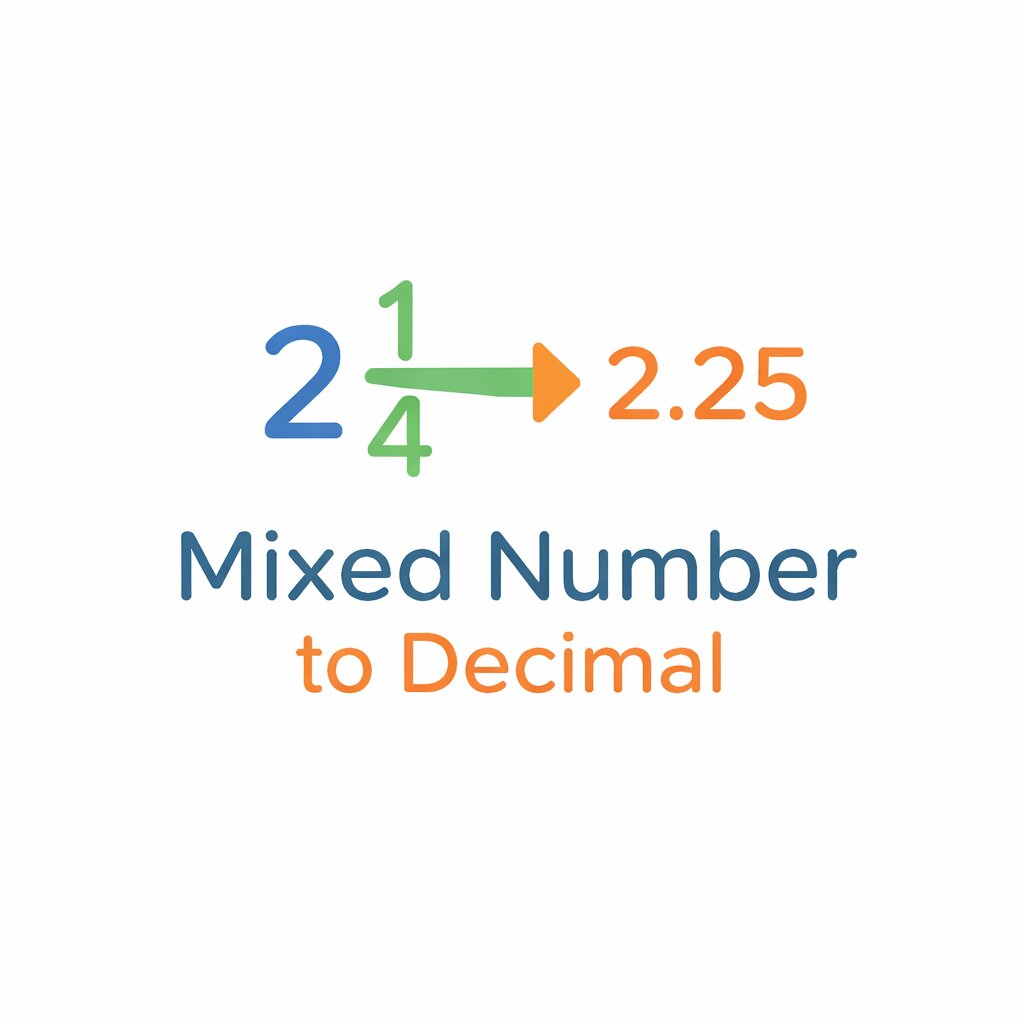
Use this mixed number to decimal calculator to convert mixed numbers and mixed fractions into decimal form fast and accurately. Enter the whole number, numerator, and denominator to get the decimal result in seconds.
Use this mixed number to decimal calculator to turn a mixed fraction into decimal form in a fast and simple way. Enter the whole number, numerator, and denominator, then get the answer right away. It also works well as a mixed fraction to decimal calculator for quick checks.
How to Use the Mixed Number to Decimal Calculator
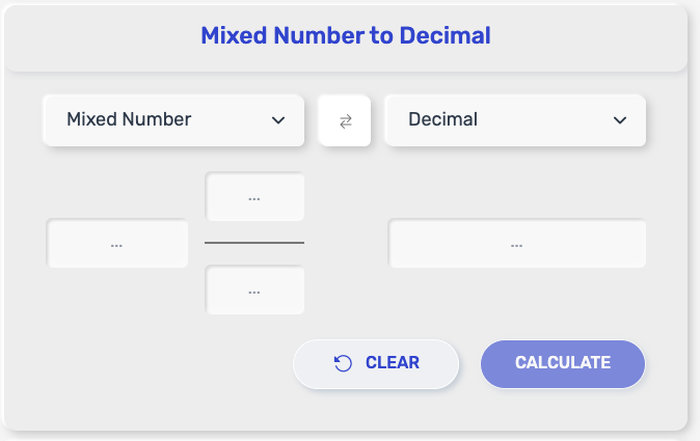
Using the mixed number to decimal calculator is quick and straightforward. Just enter each part of the mixed number in the correct field and follow these steps:
Step 1: Enter the whole number Type the whole number part of your mixed number into the first input box.
Step 2: Enter the numerator Add the top number of the fraction into the numerator field.
Step 3: Enter the denominator Type the bottom number of the fraction into the denominator field. Make sure it is not zero.
Step 4: Click the calculate button Press Calculate to convert the mixed number into decimal form.
Step 5: View the decimal result The calculator will show the decimal version of your mixed number instantly.
This mixed number to decimal converter can be used for homework, math practice, quick answer checks, and everyday number conversions.
What This Mixed Number to Decimal Converter Can Calculate
This mixed number to decimal converter is designed to turn a mixed number into a single decimal value quickly and clearly. It works with a whole number and a fraction together, then gives the result in decimal form.
With this tool, you can:
Convert a mixed number to a decimal
Convert a mixed fraction to decimal form
Change mixed numbers to decimals for math problems
Turn values like 2 ½, 4 ¾, and 7 ⅛ into decimals
Check decimal answers for homework and worksheets
Use it as a quick mixed number to decimal conversion calculator for everyday calculations
It is a simple way to convert mixed fractions to decimals when you need a result that is easier to read, compare, or enter into other calculations.
What the Result Means
The result shows the decimal value of the mixed number you entered. Instead of showing the number as a whole number plus a fraction, the calculator combines both parts into one decimal number.
For example, if you enter 3 ½, the result will be 3.5. If you enter 6 ¼, the result will be 6.25. This makes the value easier to read in decimal form and easier to use in many types of calculations.
A decimal result is useful when you want to compare numbers quickly, enter values into a calculator or spreadsheet, or work with measurements and school math problems in a more direct format.
How to Convert a Mixed Number to a Decimal
You can convert a mixed number to a decimal by working with the fraction part first, then adding it to the whole number. The process is simple and only takes a few steps.
Step 1: Keep the whole number Start with the whole number part of the mixed number.
Step 2: Divide the numerator by the denominator Take the fraction part and divide the numerator by the denominator to get its decimal value.
Step 3: Add the decimal to the whole number Once you have the decimal form of the fraction, add it to the whole number.
For example, to convert 3 ½ to a decimal, divide 1 ÷ 2 = 0.5, then add 3 + 0.5 = 3.5.
The same method works for other mixed fractions. For 5 ¾, divide 3 ÷ 4 = 0.75, then add 5 + 0.75 = 5.75.
Mixed Number to Decimal Formula
The formula for changing a mixed number into a decimal is:
Decimal = Whole Number + (Numerator ÷ Denominator)
This means you keep the whole number, divide the numerator by the denominator, and then add that decimal value to the whole number.
For example:
2 ½ = 2 + (1 ÷ 2) = 2.5
4 ¾ = 4 + (3 ÷ 4) = 4.75
6 ⅕ = 6 + (1 ÷ 5) = 6.2
This mixed number to decimal formula is a quick way to convert mixed fractions into decimal form when you want a single number instead of a whole number and fraction together.
Common Mixed Number to Decimal Conversions
Some mixed numbers appear more often than others in math practice, homework, and quick number checks. Here are a few common mixed number to decimal conversions:
1 ½ = 1.5
1 ¼ = 1.25
1 ¾ = 1.75
2 ½ = 2.5
2 ⅓ = 2.333...
2 ⅔ = 2.666...
3 ¼ = 3.25
3 ½ = 3.5
3 ¾ = 3.75
4 ⅛ = 4.125
4 ¼ = 4.25
5 ⅝ = 5.625
These examples make it easier to spot patterns and check your answers faster. They also show that some mixed fractions turn into exact decimals, while others become repeating decimals.
Where Mixed Numbers Show Up in Real Life
Mixed numbers are not just something you see in math class. They appear in many everyday situations where a value is made of a whole part and a fraction.
You might come across values like 1 ½, 3 ¼, or 2 ¾ more often than you think, especially in practical tasks that involve measurement.
Common places where mixed numbers appear:
Cooking recipes Ingredients are often written as 1 ½ cups, ¾ tablespoon, or 2 ¼ teaspoons
Length and measurement Rulers and tape measures use values like 5 ½ inches or 3 ⅛ feet
DIY and simple construction Project notes may include sizes such as 2 ¾ inches or 1 ¼ boards
School worksheets Mixed fractions are frequently used in exercises before converting to decimals
In many of these cases, the original value is written as a mixed number, but the next step requires a decimal. For example, when entering numbers into a calculator, spreadsheet, or design tool, decimal format is usually needed.
That is where a mixed number to decimal calculator becomes useful. It lets you convert values quickly without breaking the number down manually.
If you want to see how mixed numbers connect to real-world measurements like cooking, this video gives a clear and practical example before converting them into decimals:
Repeating Decimals and Rounding
Not every mixed number converts into a short, exact decimal. Some mixed fractions produce repeating decimals, which means one or more digits continue without ending.
For example:
1 ⅓ = 1.333...
2 ⅔ = 2.666...
4 1/9 = 4.111...
This happens when the fraction part cannot be written as a terminating decimal. In these cases, the mixed number to decimal calculator may show several decimal places or round the result to make it easier to read.
Rounding is often used when you only need an approximate value. For example, 2 ⅔ may be shown as 2.67 when rounded to two decimal places. A value like 1 ⅓ may appear as 1.33 depending on the calculator settings.
This is common in schoolwork, measurements, and quick estimates where a shorter decimal is more practical. Still, when exact precision matters, it is good to remember that some mixed numbers convert into repeating decimals rather than ending decimals.
References
Cuemath. Mixed Number to Decimal - Conversion, 2 Methods, Examples https://www.cuemath.com/numbers/mixed-number-to-decimal/
Cuemath. Mixed Fraction to Decimal - Conversion, Methods, Examples https://www.cuemath.com/numbers/mixed-fraction-to-decimal/
Math is Fun. Convert Fractions to Decimals https://www.mathsisfun.com/converting-fractions-decimals.html
Khan Academy. Common Fractions and Decimals https://www.khanacademy.org/math/cc-fifth-grade-math/imp-addition-and-subtraction-3/imp-common-fractions-and-decimals-2/a/common-fractions-and-decimals
FAQ
Can a mixed fraction be written as a decimal?
Yes. A mixed fraction can be written as a decimal by converting the fractional part first and then adding it to the whole number.
What is 5 ¾ as a decimal?
5 ¾ as a decimal is 5.75. Since 3 ÷ 4 = 0.75, you add that to 5 to get 5.75.
What is 2 ⅖ as a decimal?
2 ⅖ as a decimal is 2.4. The fraction 2/5 equals 0.4, so the full mixed number becomes 2.4.
Does this mixed fraction to decimal calculator round answers?
It can. Some calculators show a long decimal result, while others round the answer to a certain number of decimal places for easier reading.
Can I use this calculator for homework and math practice?
Yes. This mixed number to decimal converter is useful for homework, worksheet checks, classroom practice, and quick answer verification.
About us
mixednumbertodecimal.com was created to make everyday math conversions easier and faster. Whether you are solving homework problems, checking classwork, teaching students, or reviewing numbers for personal use, this tool helps turn mixed numbers into decimals in a simple and reliable way.
This tool was developed by the mixednumbertodecimal.com team, with contributions from developers, education-focused writers, and calculator specialists who work together to create helpful tools that are easy to understand and easy to use. Our aim is to make common math tasks feel less confusing and more manageable by giving users clear answers they can use with confidence.
Policy
We believe helpful math tools should also be clear, respectful, and transparent.
Your Privacy
Mixednumbertodecimal.com does not ask for an account or personal details. The numbers you enter are used only to perform the conversion and are not saved or shared.
Reliable Results
This tool is designed to convert mixed numbers into decimals quickly and accurately. Even so, it’s always a good idea to review the result when using it for homework, academic work, or other important calculations.
How This Tool Is Meant to Be Used
The tool is intended for learning, practice, and quick reference. It is made to simplify conversions and support understanding, but it should not be treated as a substitute for full instruction or careful review when accuracy matters most.
Changes to This Policy
From time to time, we may update this Policy to reflect improvements to the tool or related practices. Any updates will be posted here so users can stay informed.